Shopify apps: what people are really looking for
Searches like shopify apps, shopify app store, or shopify app marketplace usually mean: “I want to fix or automate something.” In support, it’s typically: inbox, returns, order status updates, and fewer repeat questions.
Shopify application (support)
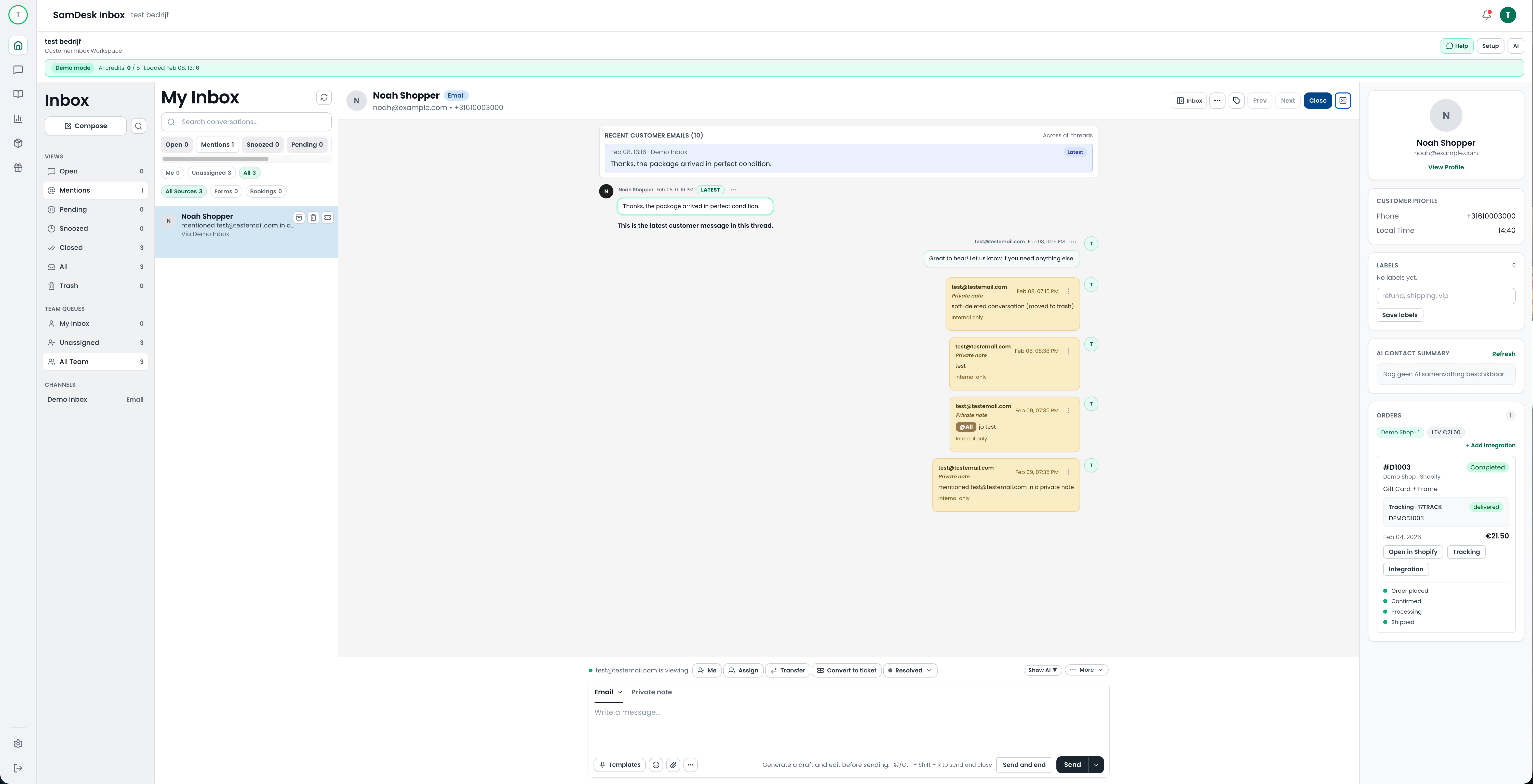
Connect support to orders so agents stop tab-switching.
Shopify help center (your own)
Knowledge base + snippets that deflect tickets.
Support for Shopify: the 10x checklist
- Order context next to every conversation (status, tracking, returns)
- Snippets + templates for top 20 questions
- Routing + ownership + SLAs per issue type
- Knowledge base: deflection + consistent answers
- AI drafts + summaries (guardrails)
WooCommerce helpdesk: what makes it different
In WooCommerce, your stack is often plugin-heavy. That means your help desk needs to be flexible (channels, routing, tags), but most importantly: show order context without friction. The foundation stays the same: inbox + tickets + customer profile.
Ecommerce CRM: why support is the starting point
Keywords like crm ecommerce often imply “more revenue.” In reality, retention starts in support: issues, returns, and delivery questions are your best product and marketing signals. That’s why ecommerce CRM should live inside support.
Shopify/WooCommerce support: integrations you actually need
The ecommerce trap is “too many apps.” A 10x setup has a small set of integrations that resolve tickets: orders, shipping, returns, and payments. Everything else is nice-to-have.
Orders & status
Line items, fulfillment, tracking, cancel/return status.
Returns & refunds
RMA flow, return labels, refund triggers.
Payments
Chargebacks, failed payments, fraud flags.
Self-serve
Knowledge base + order lookup → fewer tickets.
SamDesk vs Gorgias/Zendesk/Richpanel (ecommerce support angle)
In Shopify-land you’ll often compare Gorgias and Zendesk; Richpanel sits in-between with order/returns focus. SamDesk positions differently: one workflow for inbox + tickets + customer profile + knowledge, with fast ops setup and multilingual support.
| Use case | Where teams get stuck | SamDesk approach |
|---|---|---|
| Order questions | Tab-switching between Shopify, shipping app, and help desk. | Order context next to ticket + templates/snippets. |
| Returns & refunds | Unclear ownership + manual updates. | Workflows: routing, SLAs, statuses, proactive updates. |
| Multilingual support | Inconsistent tone and translations. | AI drafts + translation + knowledge base guardrails. |
Shopify/WooCommerce support playbook (14 days)
- Week 1: tags + templates for shipping/returns/billing; routing + ownership; top-20 knowledge base.
- Week 2: SLAs + escalations; proactive order updates; AI drafts + QA samples.
- Measure: FRT, TTR, backlog, CSAT, and deflection rate.
FAQ: Shopify help / WooCommerce helpdesk
What’s the difference between Shopify help center and your own knowledge base?
Shopify’s help center is for Shopify. Your knowledge base is for your customers and your policies (returns, shipping, warranty).
Which Shopify apps matter most for support?
The ones that speed up order context and returns/refunds. Then add nice-to-have marketing apps.
Multilingual Shopify apps intent (ES/IT)
Terms like app para shopify, mejores apps para shopify, and migliori app shopify are usually top-of-funnel. This hub covers the “support + apps + CRM” intent; we can later spin up language-specific pSEO pages if needed.