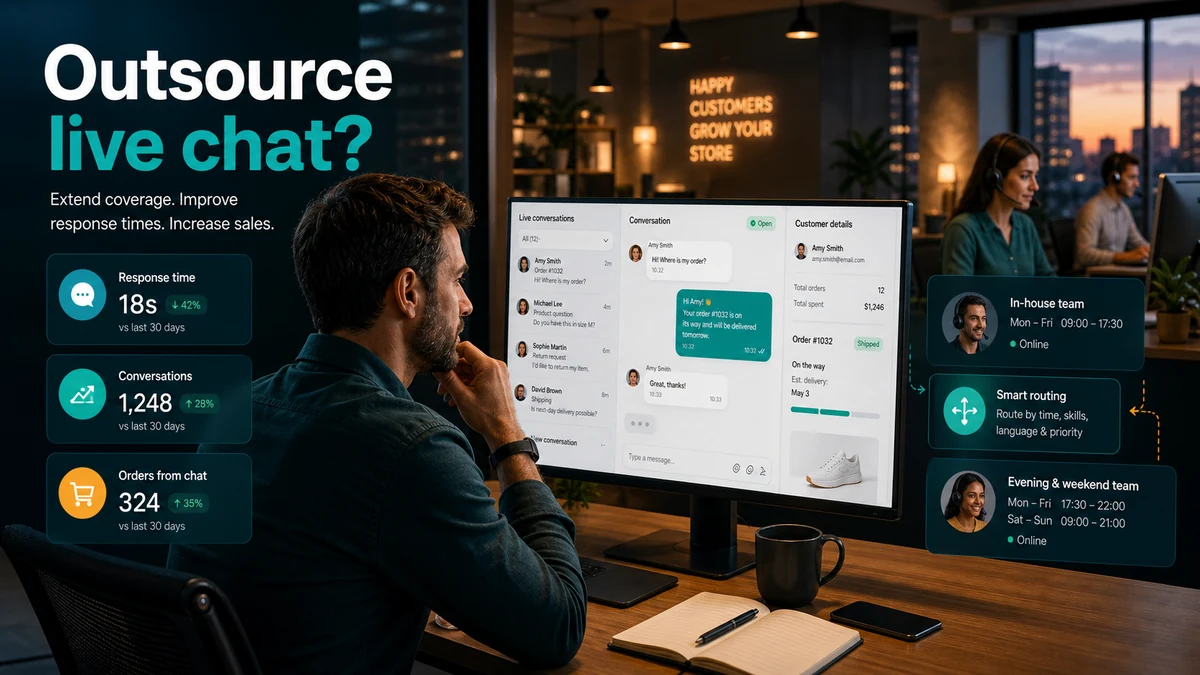
Outsource live chat or keep it in-house? A decision framework for ecommerce
When should ecommerce teams outsource live chat, and when should they keep it internal? Use this practical decision framework.
Ecommerce teams usually consider live chat outsourcing for one reason: customers expect immediate help, and the internal team cannot cover every hour. That pressure is real. Once a chat widget appears on a store, it creates a promise. If a shopper opens it, they expect an answer now, not tomorrow.
But outsourcing live chat is not automatically better. An external operator can increase coverage, but may lack context. An internal team understands your products, return rules, and exceptions, but may not be available during evenings, weekends, or campaign peaks. The right decision depends on the type of questions you want handled, the context needed to answer them, and the moments when your customers actually ask for help.
This article gives you a practical decision framework without competing with your broader live chat strategy.
Start with the job live chat must do
Do not start with vendors or pricing. Start with the job of live chat in your store.
Most ecommerce chat programs serve four jobs:
- Answer pre-sale questions: sizing, delivery timing, stock, materials, bundles, promotions.
- Explain order status: where is my order, tracking gaps, delays, address changes.
- Resolve service cases: returns, refunds, damaged items, complaints, warranties.
- Support conversion: help visitors who hesitate on product, cart, or checkout pages.
Outsourcing works best for the first and fourth job, if you have clear scripts and knowledge base content. The operator does not need deep access to order history. The question is usually advisory or sales-assistive.
Internal ownership works better for the second and third job. Those cases need context: order status, previous conversations, exceptions, payment information, and sometimes permission to approve a remedy. If an external operator lacks that context, live chat becomes a handoff layer. The customer gets a fast reply, but not necessarily a solution.
A strong setup splits those jobs. Let simple pre-sale questions move quickly, but route order and complaint cases into a unified inbox where your team sees the customer context.
When outsourcing makes sense
Live chat outsourcing can be useful when your main problem is coverage.
Imagine your store gets most buying traffic between 7 PM and 10 PM, but your support team stops at 5:30 PM. You are missing the exact window where shoppers hesitate, compare products, or abandon checkout. External chat coverage can fill that gap.
Outsourcing can also work for predictable peaks: sale weeks, Black Friday, launches, or seasonal products. You may not want to hire permanent agents for a three-week spike. External coverage can absorb first-line volume temporarily.
Use this checklist:
- Most chat questions are repeatable and easy to document.
- You have clear rules for what can and cannot be promised.
- Order questions can be identified and escalated to internal support.
- You accept that external operators will not resolve every case.
- You measure not only response time, but also handoff quality, repeat contact, and conversion assist.
If most answers are yes, outsourcing may be efficient. If most answers are no, you may be buying speed without resolution quality.
When live chat should stay in-house
In-house live chat is stronger when quality, nuance, and customer context matter more than pure availability.
That is common for stores with complex products, subscriptions, high-value orders, custom items, or sensitive complaint handling. A shopper asking whether a product fits a specific situation does not need a generic script. A customer asking about a delayed refund for the third time should not have to explain the whole case again.
Internal chat also works better when live chat is part of your support operation rather than a standalone sales channel. You want chat conversations visible next to email, return requests, order data, and previous contact history. Otherwise chat creates another archive your team must search later.
Keep live chat internal when:
- Agents often need order data or customer history.
- Your products require detailed advice or exception handling.
- Chat often leads to refunds, return labels, or escalations.
- You want chat data to improve products and support processes.
- Brand tone is important and hard to reduce to scripts.
In that situation, the question is not "how do we outsource chat?" It is "how do we make our internal team fast enough?" The answer is better routing, macros, AI draft replies, and clear opening hours.
The hybrid model is often best
For many ecommerce teams, the strongest option is hybrid. You do not outsource "live chat" as a whole. You outsource specific moments or question types.
A practical model:
External:
- evening and weekend coverage
- first triage
- simple product questions
- lead qualification
- standard delivery or stock questions
Internal:
- complaints
- refunds
- return exceptions
- order problems
- B2B or VIP customers
- questions requiring customer history
This model only works when handoff is structured. An external operator should not close with "we will get back to you" without an owner, deadline, and context. Use fixed escalation fields: order number, question type, urgency, promise made, summary, and required action.
Every external conversation should land in your internal inbox. Not as a loose transcript email, but as a usable case with status and owner. Otherwise you only move work from chat to email.
Metrics that show whether outsourcing works
Many live chat providers lead with speed: replies within seconds, wider opening hours, more conversations. That matters, but it is not enough.
Track at least five metrics:
- First response time: how fast does the customer get a first reply?
- Resolution rate: what percentage is solved without internal follow-up?
- Escalation quality: how many handoffs miss useful context?
- Repeat contact: how many customers return with the same question?
- Conversion assist: how many chats support a purchase or demo request?
An external team can look excellent on response time and poor on resolution. In that case, the dashboard looks positive while your internal team still cleans up the mess. An internal team may be slower but solve more cases in one touch.
Judge live chat by outcomes, not only availability.
Decision matrix by question type
Use this matrix to assign ownership by intent.
| Question type | Context needed? | Risk of wrong answer | Best owner | | --- | --- | --- | --- | | Product advice | Low to medium | Medium | External or internal with scripts | | Pre-purchase delivery timing | Low | Low | External possible | | Post-purchase order status | Medium | Medium | Internal or hybrid | | Return exception | High | High | Internal | | Refund status | High | High | Internal | | Complaint or escalation | High | High | Internal | | Lead qualification | Low | Low | External possible |
The rule is simple: the more context and risk a case has, the closer it should stay to your own team.
Two-week pilot plan
If you want to outsource live chat or run a hybrid model, start small.
Week 1: define the boundaries
- Choose no more than five question types external operators may handle.
- Write short answer rules and forbidden promises.
- Create escalation rules for complaints, refunds, and order problems.
- Add tags for external, internal, resolved, and follow-up needed.
Week 2: run the pilot
- Start with after-hours coverage only.
- Review ten conversations daily.
- Measure handoffs and repeat contact.
- Update scripts based on real conversations.
- Decide after two weeks whether to expand.
This prevents giving away too much control too early. You first learn which questions are safe to handle externally and where customer context is essential.
SamDesk route
SamDesk is not an outsourced contact center. It is the operational layer that makes internal or hybrid live chat manageable. Your team sees chat, email, customer context, and order information in one workspace. That means you can combine external triage with internal resolution without losing conversations in separate tools.
If you want live chat to improve speed without losing context, start with one question: which conversations can be external, and which must stay in your support workflow? Then configure routing, ownership, and measurement around that answer.
To make that concrete, explore the SamDesk live chat page or review pricing to plan the right setup.
Frequently asked questions
When does live chat outsourcing make sense for ecommerce?
Outsourcing makes sense when the main need is after-hours coverage, peak support, or lead qualification, and the questions can be standardized. Keep complex order, return, refund, and complaint cases internal or route them with clear escalation rules.
What is the biggest risk of outsourcing live chat?
The biggest risk is context loss. An external operator can answer quickly, but without order data, customer history, and decision rules, the result can be repeat contact or incorrect promises.
Can live chat be partly outsourced?
Yes. Many ecommerce teams use a hybrid model: external coverage for evenings, weekends, or first triage, and internal ownership for cases that need order context, refunds, complaints, or exceptions.
Want to see SamDesk in action?
Schedule a personal demo and discover what SamDesk can do for your team.
Book a demo